← Episode 1: about applied asymptotology, déjà vu & jamais vu
The first episode is, as any first episode should be, a fugue that rehearses — and contains, in a way — the whole novel within itself, introducing many of the repeated symbols and imagery, but also the general unified tone of the work. Like the book, it follows “poetic logic” instead of traditional narrative logic. A lot of things are contained and at least attempt to happen in the episode, linked together by association rather than by cause through a spiral / whirlpool / montage of various sensory imagery, then this microcosm is scaled up to the whole book.
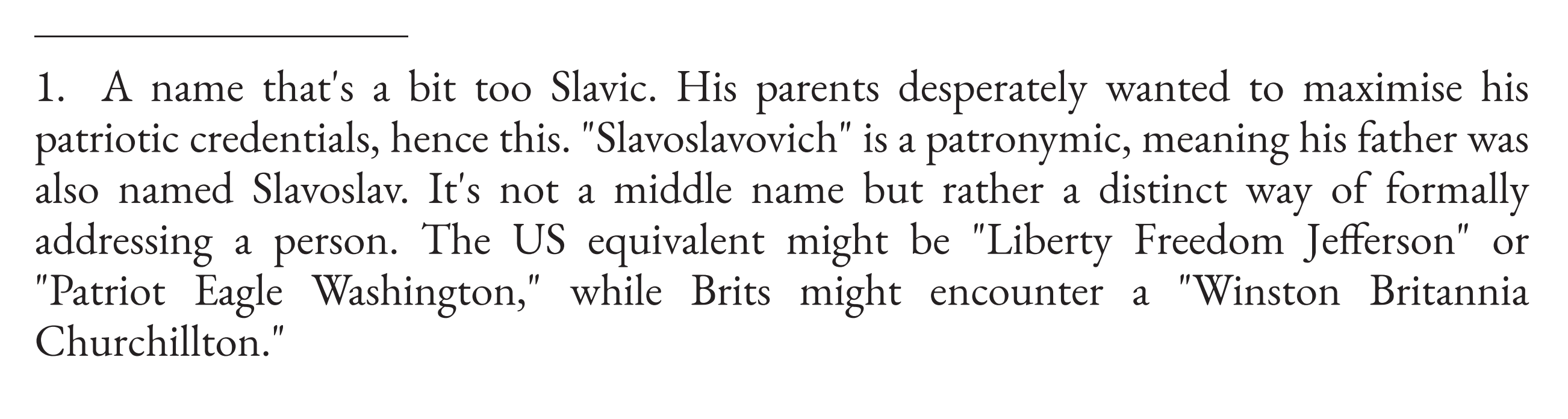
One of such features / techniques of Tulubaikaporia, at least in its English translation, is commentary comprised of footnotes by yours truly. As a translator, it was tough to decide what I should talk more about and what less and what I should completely ignore and let the reader figure out and what is a necessary “Russian context” that, even though it’s not essential for reading and comprehension, can enrich the experience beyond just text, so the novel, for better or worse, also plays as a little encyclopaedia for a particular strata of Russian reality. They are, however, not just academic explanations of particular terms and phenomena but indeed a commentary that, as I hope, have their own voice and tone and sometimes turned out to be as digressive as the main text often is, even turning into mini-essays once in a while, which was, well, a lot of fun! Look at these few from the Episode One, a footnote for “Slavoslav Slavoslavovich” and what’s avos’:

Here are some additional materials and commentary, including music, paintings, and photos that couldn’t make it to the footnotes, so you could IMMERSE yourself into it even more, using other senses. Some of these concepts and imagery are crucial to the book and appear in the later episodes as well, so knowing how some things “look” and “feel” might only make you more Tulubaikan, which is the endgoal, ngl.
Letov's Ophelia
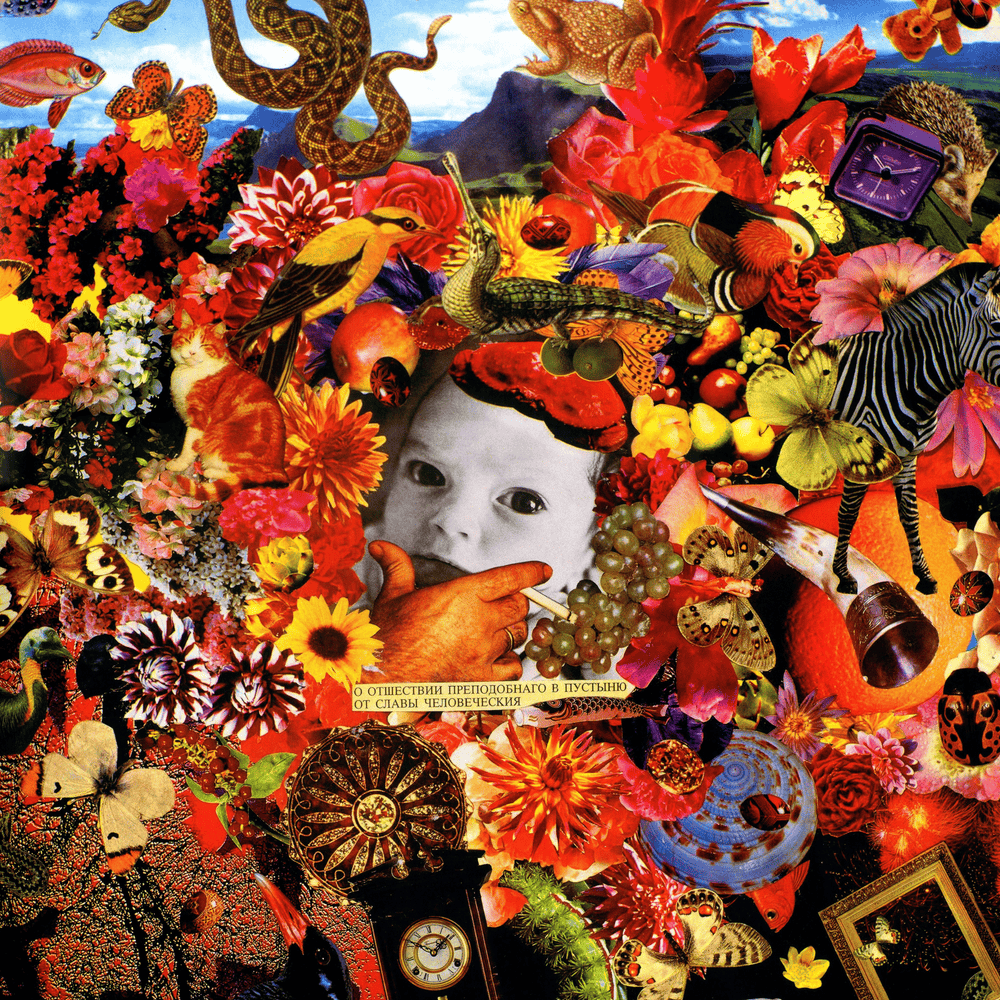
Egor i Opizdenevshie · Сто лет одиночества (100 Years of Solitude), 1993
Two songs are woven through the entire chapter: Yegor Letov’s “Ophelia” and Pink Floyd’s “Wish You Were Here” that fuse into one at the end of the episode, using the rhythmic patterns of Letov’s song with Pink Floyd’s lyrics with some borscht inflections.
The episode also shares my translation of “Ophelia” with one missing second stanza. Below — genuinely exclusive — full translation:
Distant Ophelia laughed in her sleep:
A pot-bellied thrush, a shaggy deer
The habitually last year’s painted snow
Easily, lightly and cheerfully crunches on teeth.Dressed-up Ophelia flowed over the brim:
A serpentine honey, a raspberry poison
A rubber little tramcar, a zinc-coated May
An expired little ticket to the show’s rerunEnamoured Ophelia drifted far away
The night was bright, the earth did ring
Hastily hurried, without hiding from view
The clock to its foolish, comical landObedient Ophelia floated to the east
A wondrous captivity, granitic delight
A lemony pathway to an orange grove
Invisible lift to a transcendent floorDistant Ophelia laughed in her dreams:
A weary demon, a willow bush
Gifted ponies scattered at dawn
To the four winds — try to catch them now—
The translation’s aggressively-literal but I don’t think you can or should translate Letov’s surreal adjective-noun game and grammar-as-surrealism game (the way he stacks up modifiers and scatters idioms without logical hierarchy) using any other approach, more so, not sure one should translate Letov at all but, alas, I did already!
How Letov described the making of this song in an interview:
…It [creative work] comes about like a waterfall, a fountain, but only after you’ve been knocking at the door for a very long time. Just like that, if you’re not doing anything, nothing comes about. I, for instance, from about ‘98 to 2000 did absolutely nothing — just gave concerts, drank, lived for my own pleasure — and nothing got composed whatsoever. Only when a particular urge arises, when you start to sort of… professionally (that’s probably what professionalism actually is) knock at certain doors… track things down…
Take for example, how did “Ophelia” come about? I had this rough poem about Piter — that is, I was composing a little poem about the blockade in Leningrad — “In blockaded Leningrad the clocks are in no hurry…” — about what is NOT yet happening there, and what is happening. Wrote it for a long time and realised something was off about it. And at a certain moment, when I was walking about and searching… hunting, like a professional hunter… I generally hold the view that all of us — those of us who compose things — are not in fact authors. We are some sort of conductors of something that exists somewhere… everywhere. For this you need to muster a certain courage and sign up for the fact that you agree to pay for plugging into this and doing this thing. The payment can sometimes be very cruel and severe, judging by the way artists die all around… As a result of which you grab hold of the thing, and through you passes a kind of current.
Ophelia in Painting
Millais’ “Ophelia”, depicting Shakespeare’s Ophelia floating among wildflowers as she — serene, oblivious, beautiful — drowns, was the painting that directly inspired Letov to write the song that made it into Tulubaikaporia. In the Episode One, however, Ophelia drowns not in a stream but in a pot of borscht.
How I wish, how I wish you were here
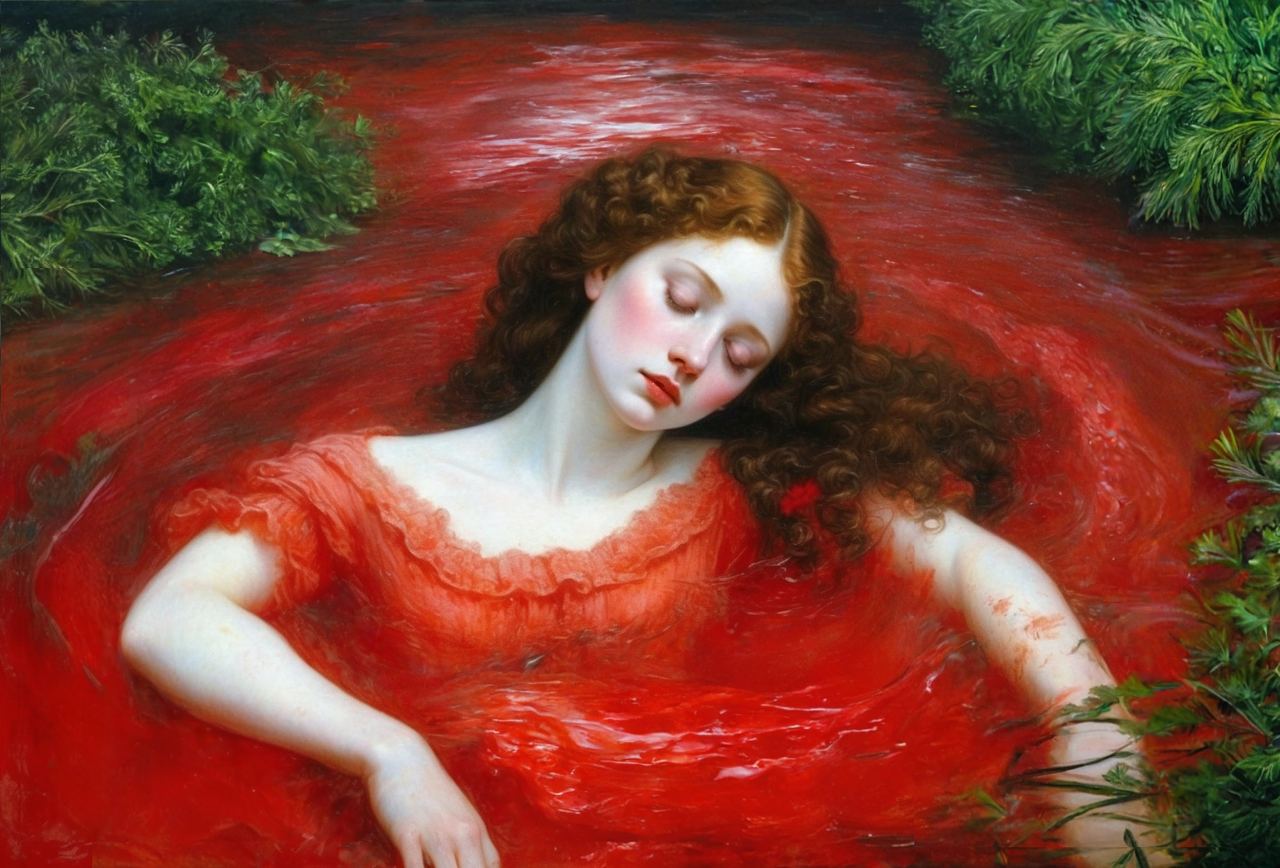
Ophelia drowning in a borscht bowl, year after year
Running over the old ground, what have we found?
The same old fears, I wish you were here.
John Everett Millais — Ophelia (1851–52)
Oil on canvas · Tate Britain, London

Public domain · Wikimedia Commons

Despite Millais’ painting being seemingly the most famous, many other artists over the years painted Ophelia, too. John William Waterhouse was so obsessed with the lady that he painted her three times in different settings, here’s the best one:
John William Waterhouse — Ophelia (1894)
Oil on canvas · Private collection
Possibly the most recognisable of Waterhouse’s Ophelias.

Public domain · Wikimedia Commons
.jpg)
Then we have a by no means exhaustive variety of other Ophelias: the most dramatic by Alexandre Cabanel, the most symbolist by Odilon Redon, and the most drowned by Paul Albert Steck:
Alexandre Cabanel — Ophelia (1883)
Oil on canvas · Private collection

Public domain · Wikimedia Commons

Odilon Redon — Ophelia (c. 1900–05)
Pastel · Symbolist

Public domain · Wikimedia Commons

Paul Albert Steck — Ophelia (1894)
Oil on canvas · Petit Palais, Paris

Public domain · Wikimedia Commons

And to close the Ophelia parade, the AIphelia drowning in the river of borscht:
Chort
A significant figure in Russian literature, this guy. Sometimes he’s more folkloristic (Gogol), sometimes more religious (Dostoevsky), sometimes more secular (Chekhov) but it’s always the same guy, a supernatural satyr-like trickster who leads humans into the darkness through the means of cosmic irony, in a sense, a minor Faustian Devil figure who deceives humans for the love of the game. In the Episode One, he (almost) emerges from the fridge:
Here the powerless fridge under the cat could have suddenly turned on, hummed, shaken, its door could have swung open and out he’d come — the sly one himself, looking like a chort, hairy, with polished horns and hooves. And we’d sit together with him, and knock back pure Tulubaikan samogon and chase it all down with toasted bread with demonic amounts of garlic, of which he, the sly one, wouldn’t be afraid and would have prepared it for us in the fridge converted into an oven. But no, life isn’t like that. Alas
One of the best canonical descriptions of chort that inspired Vanechka can be found in Chekhov’s A Conversation Between a Drunken Man and a Sober Chort:
Do you know what a chort is? It’s a handsome young man, with a mug as black as his boots and with red expressive eyes. On his head, although he isn’t married, he has little horns… and a hairdo a la Capoul. His body is covered in green wool and smells like a dog. At the bottom of his back dangles a tail ending with an arrowhead… Instead of fingers he has claws, instead of feet he has horse hooves. Seeing the chort, Lakhmatov became somewhat troubled, but then, remembering that green chorts have a silly habit of appearing to all generally tipsy people, he soon calmed down.
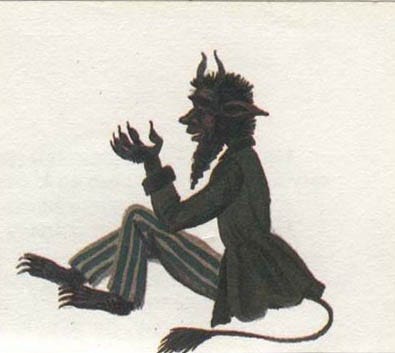
I dared not translate “chort” and render it as it is, because, well, typical translations like “demon” or “devil” are rather ambiguous. The devil has clear Satan connotations, and a demon isn’t distinct enough, while a chort is a Slavic folklore creature. Russian: чёрт, Belarusian and Ukrainian: чорт, Serbo-Croatian čort or črt, Polish: czort and czart, Czech and Slovak: čert, Slovene: črt. So introducing the term directly to English is more than fair, given it’s so easy to read and pronounce, too.
You won’t believe it, but a short story featuring a chort began the idea of writing about Tulubaika even though it didn’t make it into the book eventually, for it belongs to a different cycle.
Various pictures of chort for your enjoyment (don’t go blind):
Tarasenko — На чёрте (Riding the Chort)
Vakula riding the Chort, from the story by Nikolai Gogol, The Night Before Christmas. Drawing by Tarasenko, which illustrated the edition published by the bookshop of Dumnov, under the firm “Heirs of the Salayev Brothers,” 1887.

Public domain · Wikimedia Commons
Ivan the Fool and the Chort
Russian fairy tale illustration

Public domain · Wikimedia Commons

Cert — folk figure in procession
Czech/Slovak tradition · Carved wooden figure

CC BY-SA 3.0 · Wikimedia Commons

Wooden chort statue
Folk carving

CC BY-SA 3.0 · Wikimedia Commons
.jpg)
Borscht
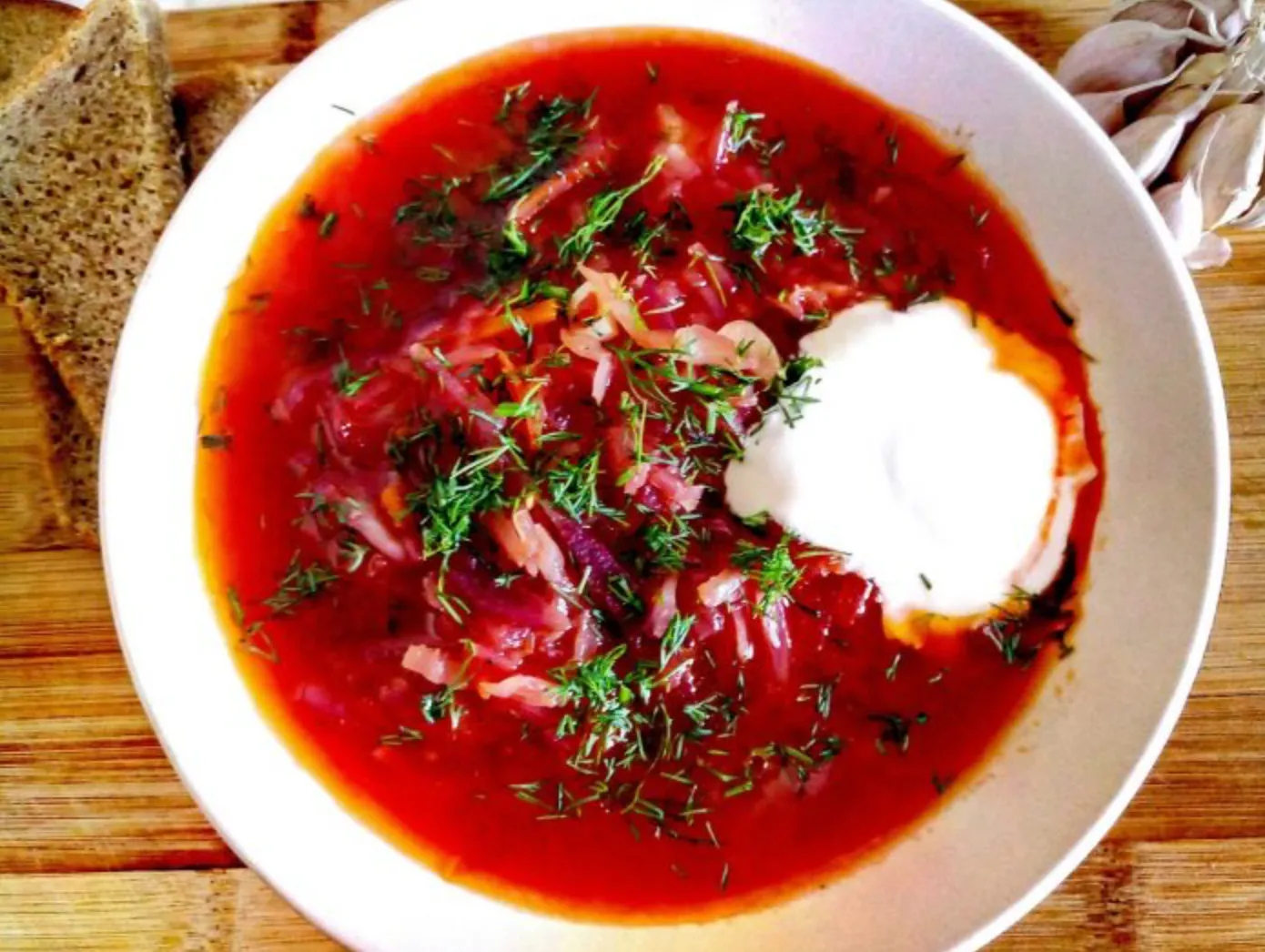
Today we’re learning how to cook a majestic borscht. This isn’t my family recipe and not a personal twist on the famous classic, it’s just a satisfying variation of it. It captures the dish quite well, including both taste and unique red colour. The instructions I saved were written in Russian and I don’t know the source now. I’m translating them for you with some small alterations. I usually cook it with beef, but you can go for vegetarian or vegan options that just drop meat. It’s normal to cook a lot of it and eat for three days, depending on how many people you cook for. For roughly 8 portions, you’ll need the following ingredients:
Ingredients
- 14 cups Water
- 1.5–1.75 lbs Beef brisket or Beef shin
- 12 oz Fresh cabbage
- 8 oz Potatoes
- 5 oz Beets
- 3.5 oz Carrots
- 5 oz Onions
- 10 oz Tomatoes
- 1/4 cup Vegetable oil
- 3 cloves Garlic
- 2–3 Bay leaves
- Salt, to taste
- Black pepper, to taste
- Dill, to taste
- 1 teaspoon Sugar
- 1 teaspoon Lemon juice (for acidity, keeps the colour)
- Smetana / sour cream, for serving
Preparation
Step 1. Transfer meat to a pot, cover with cold water, bring to a boil while periodically removing the foam that forms from the meat. Reduce the heat to a minimum, add one small peeled onion, salt, and let the broth simmer for 1–1.5 hours. A rich broth for borscht is obtained from beef on the bone, in which case the beef on the bone should be cooked for at least two hours. It is best to cook the broth over low heat so that it is rich and the vegetables in the borscht do not overcook. You can skip this step if you go for a veggie option.
Step 2. While the broth is cooking, prepare the vegetables. Peel the beets and carrots and cut them into thin strips. Shred the cabbage into thin strips as well. You can grate them if you prefer. Cut the onions into quarter rings to get short strips. Grate the tomatoes (if you don’t have tomatoes, you can add tomato paste). Peel the potatoes and cut them into medium-sized cubes or strips to your liking.
Step 3. Prepare the beets separately in advance, as they are a dense vegetable and take a long time to cook. In a separate pan or saucepan, pour 2–3 tablespoons of vegetable oil, heat it, and add the chopped beets. Season with salt, add a teaspoon of sugar, and sprinkle with lemon juice so that the beets do not lose their colour. If you don’t have lemon juice, you can add a drop of vinegar. Pour a ladle of broth from the pot, cover, and stew for about 20–25 minutes over low heat, stirring constantly. In a separate pan from the beets, pour vegetable oil and add a small piece of butter. Add the onions and saute for about 3–4 minutes. Then add the carrots and continue sauteing for 5 minutes, stirring constantly. Add the grated tomatoes, salt, and pepper to taste, and continue frying over low heat until the tomato juice has evaporated, stirring occasionally.
Step 4. Remove the meat from the pot with the broth and cut it into pieces. Add the chopped meat, potatoes, and cabbage to the broth and continue cooking for 12–15 minutes. Then add the sauteed vegetables and bay leaves, and cook for 10–15 minutes. Taste for salt. Then add the cooked beets, bring to a boil, add black pepper, finely chopped garlic, and herbs to your taste. Cover and remove from heat. Let the borscht sit for about 20 minutes.
Step 5. AND DONE! Serve it with sour cream and herbs like fresh parsley, spring onions, and dill. Optionally, you can also add croutons or eat it with slices of rye bread.
Firebird
Slavoslav Slavoslavovich finishes wiping the bottle with a towel decorated with firebirds. The birds absorb the bubbles of cava and fly off tipsy to winter in Tahiti. Whoosh! And they’re gone. There they hustle, stay and live, have children, and never return either to Tulubaika or to the surrounding villages.
Boris Zvorykin — Firebird

Public domain · Wikimedia Commons

Felix Dzerzhinsky
— One every day, — says my doctor, his fake clownish moustache turning him into Felix Dzerzhinsky. — Best in the arse cheek. Right or left — you pick. But I stick it in the left — I fancy commies, you know. Go on, give it a go.
Felix Dzerzhinsky — “Iron Felix”
Founder of the Cheka (the original KGB) · 1877–1926
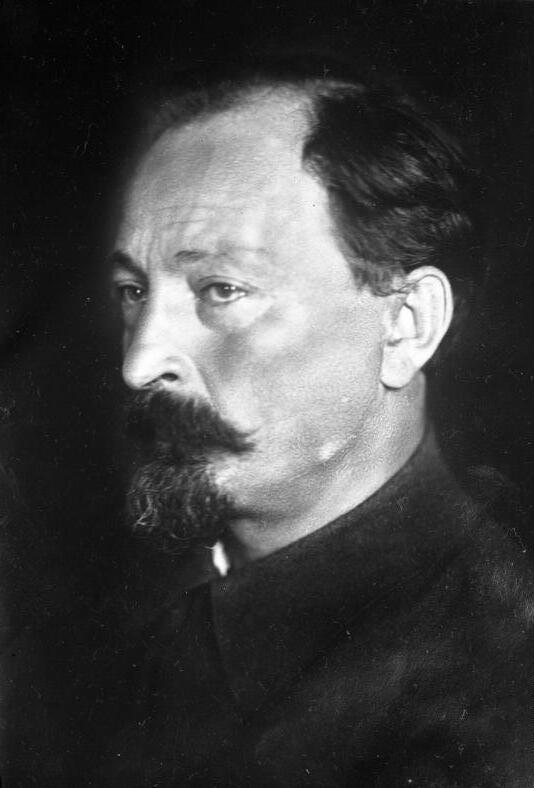
Bundesarchiv · CC BY-SA 3.0 · Wikimedia Commons

The Toppling of “Iron Felix” — August 22, 1991
Lubyanka Square, Moscow

CC BY-SA 3.0 · Wikimedia Commons

Opel Kapitan Cabriolet
Before him, as in a fairy tale, appears a slightly rusted but clean Opel Kapitan Cabrio, coloured like Schutzstaffel uniform, full of rounded forms, equipped with bug-eyed headlights and a distinctive radiator grille, that very legendary car on which Slavoslav Slavoslavovich’s grandfather drove from Germany in nineteen forty-five, fuming home victoriously to Tulubaika, minus one ear and two fingers on his right hand that were scattered around Europe.
Opel Kapitan Cabriolet (1939)

CC BY 2.0 · Wikimedia Commons

Tsar Cannon
— Complete jamais vu, comrade… — A function discontinuity… — Alephtina mutters and winces from an apparent attack of her mathematical synaesthesia. — Flush it down, — says Slavoslav Slavoslavovich and gives her his freshly prepared portion of Tsar Cannon (thus we call our concoction).
Tsar Cannon (Царь-пушка)
Moscow Kremlin · Cast 1586 · 38 tonnes · Never fired

CC BY-SA 3.0 · Wikimedia Commons

Bukhanka
A boozer uncle of mine in Tulubaika once had his hands so scratched up by his cat that my aunt thought he’d tried to cut his wrists, called the shrinks, who somehow packed him into a straitjacket and carted him off in a white bukhanka to the yellow house.
UAZ-452 “Bukhanka” (Буханка)
Produced since 1965 · “A loaf of bread on wheels”

CC0 · Wikimedia Commons

Samogon
By copper’s will and Alephtina’s wish, the vessel brims with cava and samogon’s swish.
The Samogon Apparatus

CC BY-SA 3.0 · Aaronstj / Eupator · Wikimedia Commons · licence
