A significant figure in Russian literature, this guy. Sometimes he’s more folkloristic (Gogol), sometimes more religious (Dostoevsky), sometimes more secular (Chekhov) but it’s always the same guy, a supernatural satyr-like trickster who leads humans into the darkness through the means of cosmic irony, in a sense, a minor Faustian Devil figure who deceives humans for the love of the game. In the Episode One, he (almost) emerges from the fridge:
Here the powerless fridge under the cat could have suddenly turned on, hummed, shaken, its door could have swung open and out he’d come — the sly one himself, looking like a chort, hairy, with polished horns and hooves. And we’d sit together with him, and knock back pure Tulubaikan samogon and chase it all down with toasted bread with demonic amounts of garlic, of which he, the sly one, wouldn’t be afraid and would have prepared it for us in the fridge converted into an oven. But no, life isn’t like that. Alas
One of the best canonical descriptions of chort that inspired Vanechka can be found in Chekhov’s A Conversation Between a Drunken Man and a Sober Chort:
Do you know what a chort is? It’s a handsome young man, with a mug as black as his boots and with red expressive eyes. On his head, although he isn’t married, he has little horns… and a hairdo a la Capoul. His body is covered in green wool and smells like a dog. At the bottom of his back dangles a tail ending with an arrowhead… Instead of fingers he has claws, instead of feet he has horse hooves. Seeing the chort, Lakhmatov became somewhat troubled, but then, remembering that green chorts have a silly habit of appearing to all generally tipsy people, he soon calmed down.
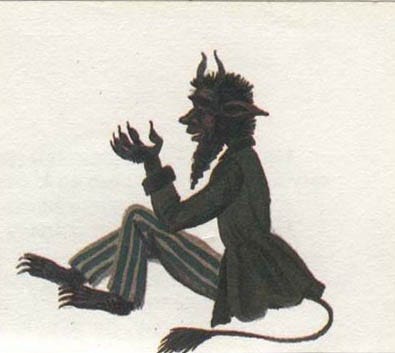
I dared not translate “chort” and render it as it is, because, well, typical translations like “demon” or “devil” are rather ambiguous. The devil has clear Satan connotations, and a demon isn’t distinct enough, while a chort is a Slavic folklore creature. Russian: чёрт, Belarusian and Ukrainian: чорт, Serbo-Croatian čort or črt, Polish: czort and czart, Czech and Slovak: čert, Slovene: črt. So introducing the term directly to English is more than fair, given it’s so easy to read and pronounce, too.
You won’t believe it, but a short story featuring a chort began the idea of writing about Tulubaika even though it didn’t make it into the book eventually, for it belongs to a different cycle.
Various pictures of chort for your enjoyment (don’t go blind):
Tarasenko — На чёрте (Riding the Chort)
Vakula riding the Chort, from the story by Nikolai Gogol, The Night Before Christmas. Drawing by Tarasenko, which illustrated the edition published by the bookshop of Dumnov, under the firm “Heirs of the Salayev Brothers,” 1887.

Public domain · Wikimedia Commons
Ivan the Fool and the Chort
Russian fairy tale illustration

Public domain · Wikimedia Commons

Cert — folk figure in procession
Czech/Slovak tradition · Carved wooden figure

CC BY-SA 3.0 · Wikimedia Commons

Wooden chort statue
Folk carving

CC BY-SA 3.0 · Wikimedia Commons
.jpg)