Origins of a book are vague and mysterious and hardly can be pinned to a single evening when the author was like, uh-huh, now I have this wonderful idea for the book the whole narrative of which is totally in my head, I just need to sit down and type it all. On the contrary, there are multiple origins, and now, retrospectively, the two most important ones are a story about waiting for the bus to Tulubaika (that is now Episode 7), and a collab with my brother, series of comedic picaresque misadventures of Khorya and Borya where they’re going back to Tulubaika to achieve happiness (get some lucres, famous Tulubaikan samogon, busty women, etc. by their account). They cycle there and on the way meet various creatures from Eurasian folklore under rather postmodern circumstances. This was supposed to be an important part of the book originally spanning multiple episodes, which would have made the book more comedic. Despite having quite a few ideas, we ended up writing only two. So, technically, the first one — the one that aligns with Tulubaikan mythos the most, the one that I like the most — can be named the very origin of the book, and it would be only right for me to pay regards to it, to my brother, and, even though it didn’t get to the book, which ended up being a different beast altogether, include it in the extras as a bonus story.
And here it is — How Khorya and Borya Trafficked a Chort.
~ ~ ~
The taxi radio is running “a demonic rendition of Shostakovich”, and we have already been here — Episode 4 named the piece and the treatment: String Quartet No. 8, allegro molto, breakcore flip. Episode 6 doesn’t say which rendition. It doesn’t have to.
For contrast, the same movement played straight, by the Emerson Quartet:
Golden Birches / Underfoot
what an abominable muck Tulubaika is this time of year but what beauties those golden birches are and what a delight it is to gaze at them and stroll around if of course you don’t look under your feet
Isaac Levitan — Golden Autumn (1895)
Oil on canvas · Tretyakov Gallery
Eyes up.
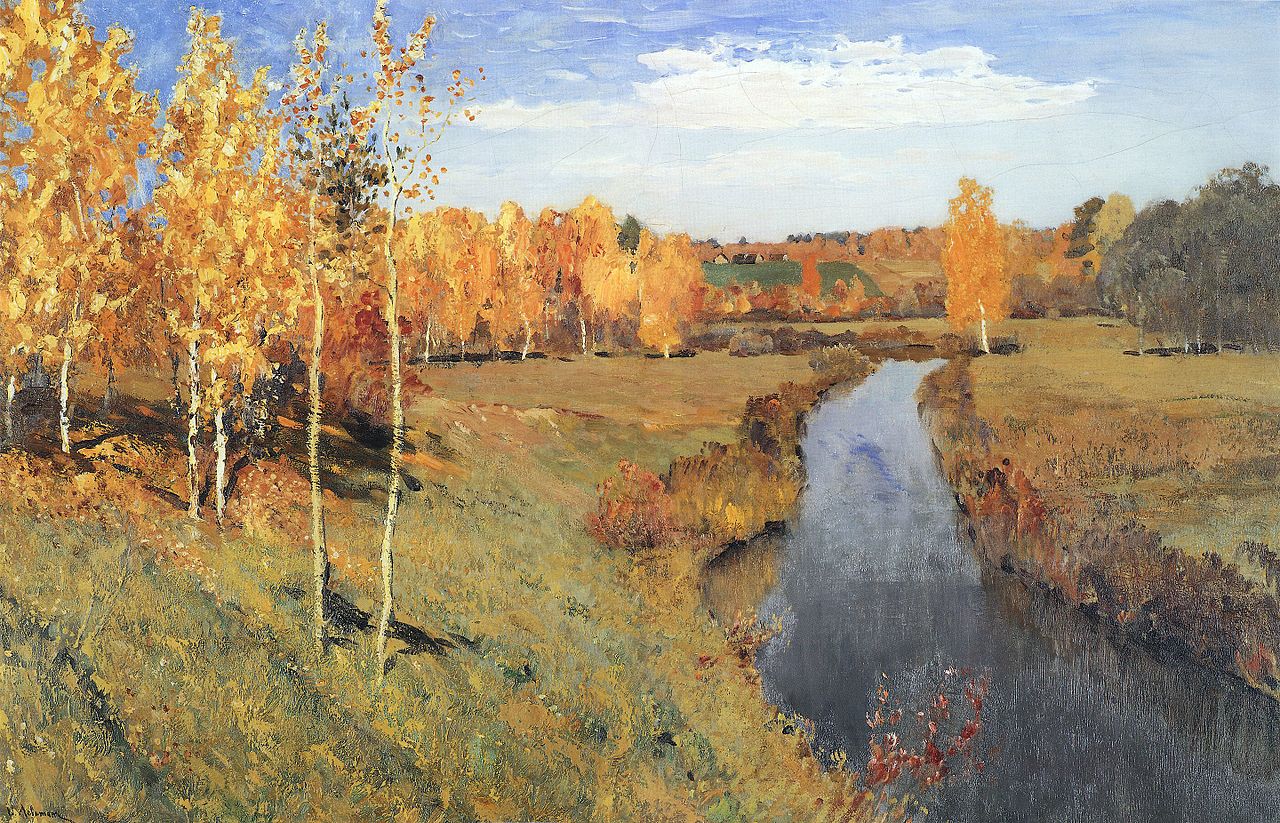
Public domain · Wikimedia Commons

Alexei Savrasov — Country Road (1873)
Oil on canvas · Tretyakov Gallery
Eyes down. Same country, same season, and the subject is the ruts.

Public domain · Wikimedia Commons
.jpg)
The Fjords / The Rotavator
or ramble through the mud on a rotavator or a topless Mini Cooper through Norwegian fjords
Geirangerfjord

CC BY-SA 2.0 DE · Jörg Hempel · Wikimedia Commons · licence

The motoblok
The sentence assumes you can travel on a rotavator, and in English that reads as absurdism. It isn’t — it just needs one missing part.
A мотоблок is an engine and a gearbox on two wheels, steered by handlebars, with the operator walking behind. Implements attach for ploughing, harrowing, lifting potatoes, clearing snow. And in every manufacturer’s catalogue there is a trailer with a seat.
With the trailer on, the operator stops walking and sits down, and the thing becomes transport: slow, open to the weather, entirely serious as a way of getting somewhere with a load.
The Mini Cooper in the same line is topless. So is this.

CC BY-SA 4.0 · Вадзім Медзяноўскі · Wikimedia Commons · licence

The seated trailer, from the people who make them
Third in the book’s fleet, after the Opel Kapitän and the bukhanka.
The West End / The Cinema Counter
you won’t have plays in the West End but a cigarette-smelling Tulubaika cinema where there’s no popcorn yet there are rice and egg pasties bubliks and black chai with two spoons of sugar instead of twelve-year-old Macallan and vintage Coca-Cola Zero
Shaftesbury Avenue at night

CC BY-SA 2.0 · RichTea · Wikimedia Commons · licence

~ ~ ~
The counter
Pirozhki with rice and egg — boiled egg, boiled rice, and whatever else is going, in yeast dough.

CC BY-SA 4.0 · Pannet · Wikimedia Commons · licence

Bubliks, with their smaller and drier relatives the baranka and the sushka. Sold threaded on string.

CC0 · Ural-66 · Wikimedia Commons
.jpg)
Black chai with two spoons of sugar, in the metal holder that makes a scalding glass portable.

CC BY-SA 3.0 · Obrez · Wikimedia Commons · licence

Beatles / May Beetles
bartered May beetles for Beatles tapes
Footnote 1 tells you what it is. It can’t show you one, and the trade only works if you know what was on the other side of it.
A currency about four centimetres long that arrives on its own schedule in May, flies badly, thuds into lit windows all evening, and can be caught by hand.
Melolontha melolontha — taking off
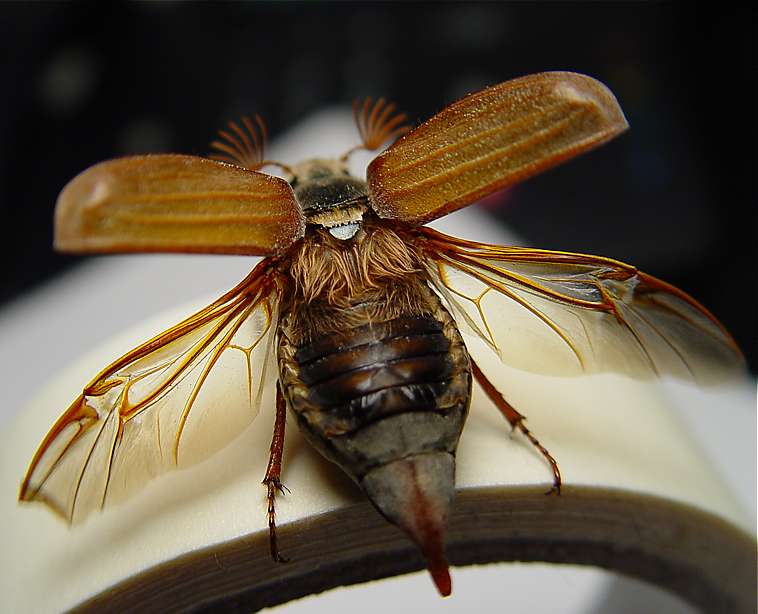
CC BY-SA 3.0 · Mario Sarto · Wikimedia Commons · licence

Monks' Chai / Hawthorn Tincture
or drink chai with Tibetan monks to a state of chai intoxication and lush peacock-like opening of chakras or drink shots of hawthorn tincture hand sanitiser surgical spirit in tandem with local pissheads yet to the same drunken opening of chakras
The episode does the work itself — yet to the same — and then closes on eyes wide shut. Nothing to add to that.
Po cha
Brick tea churned with yak butter and salt. Closer to broth than to tea.

CC BY-SA 3.0 · John Hill · Wikimedia Commons · licence

Day of the Dead / The Funeral
or listen to the singing on the Day of the Dead in Mexico or to the singing of the funeral service of Uncle Vanya
The one pair where both halves are the same activity.
José Guadalupe Posada — La Calavera Catrina (c. 1910–13)
Zinc etching
A skeleton in an enormous French hat, drawn to mock Mexicans who wanted to be European. A gold-side figure who is, on inspection, made of the mud side.

Public domain · Wikimedia Commons

Baneberry
on a dare with the lads you stuffed your mouth with baneberry your stomach twisted your face paled you nearly perished at a tender age terminally-tragically-truly-indeed spent a fortnight in hospital
No footnote for this one, and no gold half either.
Actaea spicata — воронец колосистый, European baneberry. Black, glossy, in a neat upright spike, growing in exactly the damp shaded woodland you go into for mushrooms. Every part of the plant is toxic; the berries cause violent gastric illness.
They look edible. That is the entire problem, and the reason the dare exists.

CC BY-SA 3.0 · Sten Porse · Wikimedia Commons · licence
