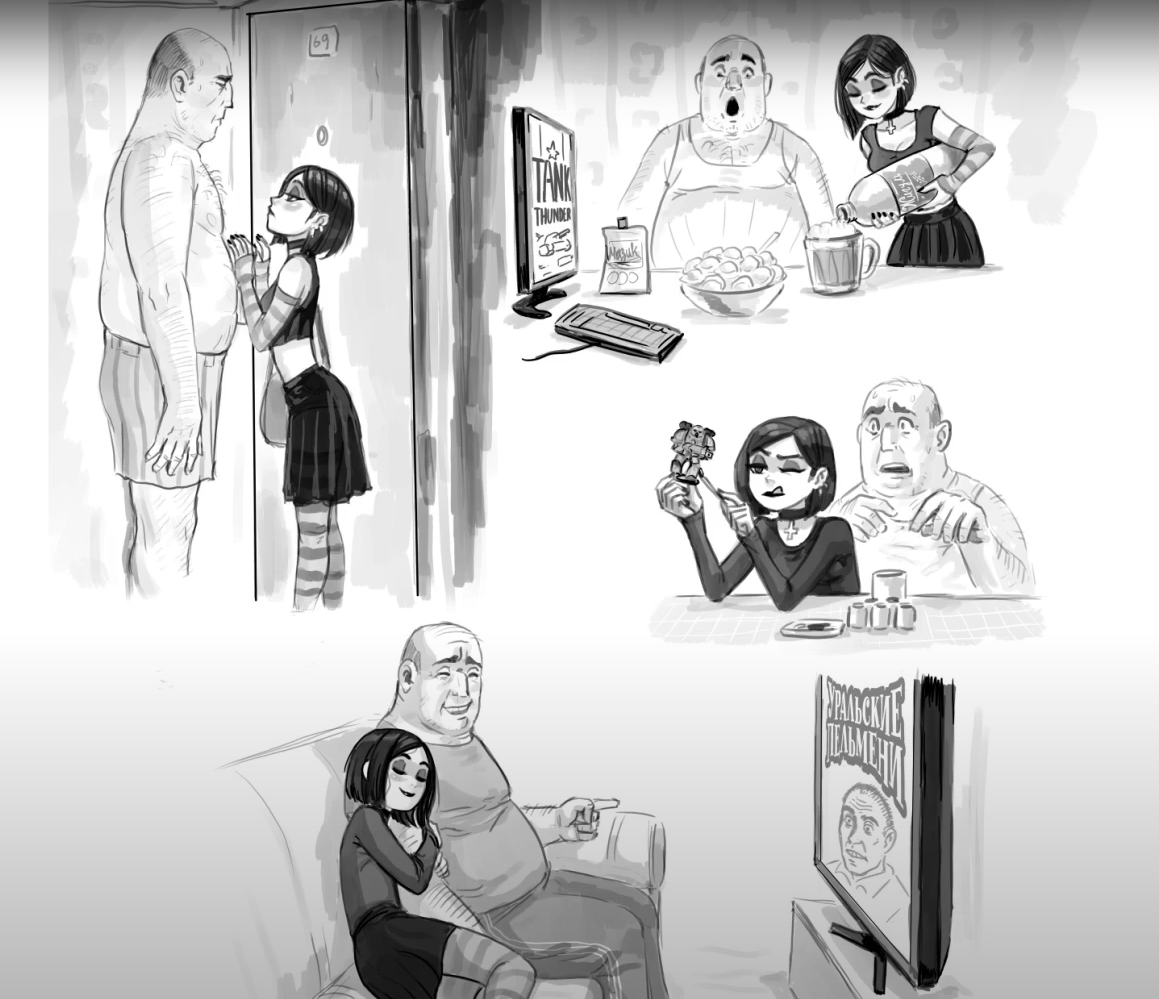
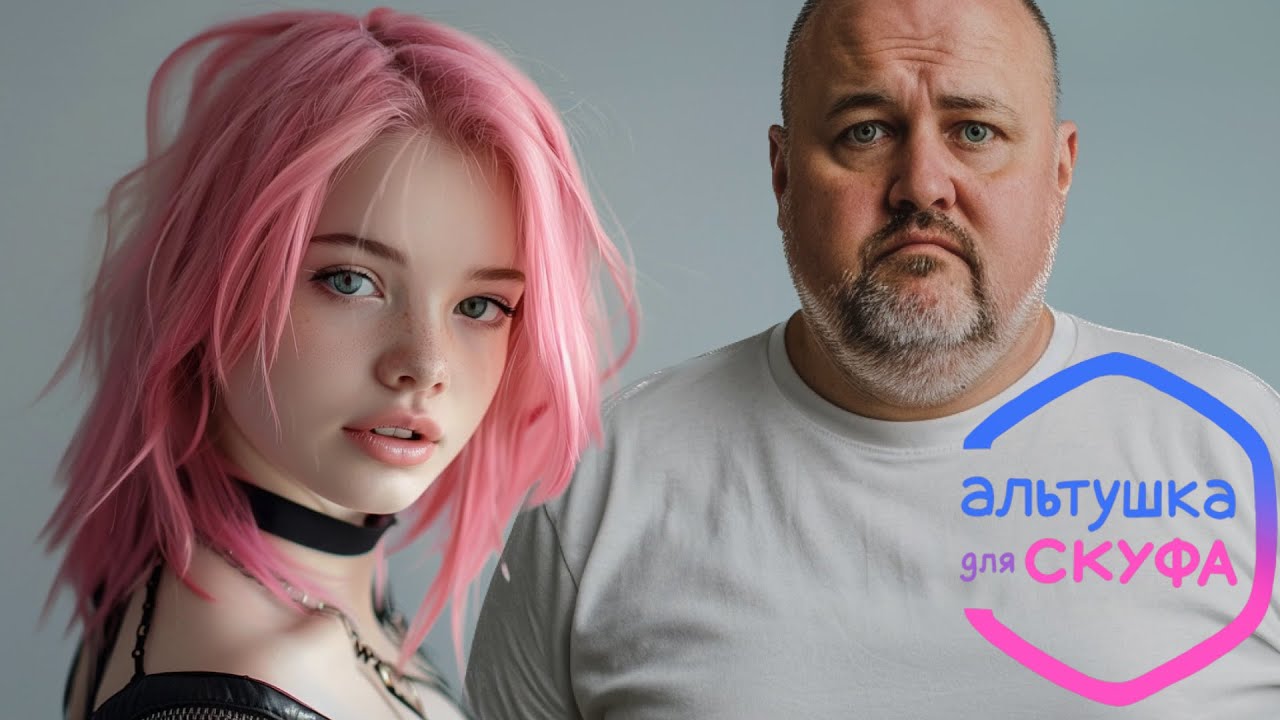
— I’m just all dreamy, mysterious, unapproachable, with a special aura of alt girlie, quiet but with volumes of Nietzsche and Machiavelli in my little black rucksack.
— I’m just a simple guy, you know? Not like those other guys. Want to come over and watch me play Counter-Strike while I drink beer from the can? I’ve got frozen pizza.
Such could be an imaginary dialogue of altushka (alt girlie) and skuf, which are explained by the footnotes in the book as follows:
Original uses “альтушка” (altushka). Even though it’s borrowed from English “alt girl”, the Russian metamorphosis of the term carries a distinctive sonic quality by adding an affectionate-yet-mocking diminutive suffix “-ушка”, hence “girlie” instead of “girl” in the translation as an attempt to convey the same tone. The “alt girlie” phenomenon became a meme around 2020-2021 in Russia and was nominated for “Word of the Year.” “Alt girlie” isn’t just any girl with “dyed hair and combat boots”, but a specific social archetype. In internet culture, the “alt girlie” became the object of desire for a particular type of man called a “скуф” (skuf), thusly creating one of Russia’s most widespread memes of 2024. The “skuf” represents men around or over 35 with unkempt appearances, dead-end jobs, and a lifestyle revolving around beer, TV, and video games, essentially the polar opposite of the aesthetically conscious alt girlie. The apogee of the meme was the appearance of the advertised possibility of finding your “alt girlie” on government websites, as well as a visual novel game called “Альтушка для скуфа” (“An alt girlie for a skuf”) that became a Steam bestseller.
“Skufidon” (скуфидон) is the final form of “skuf.” It’s a portmanteau of “skuf” and “Cupidon”, the Russian word for Cupid.
Every internet culture sooner or later ripens its own archetypes, and these archetypes can tell you everything you need to know about our culture. The skuf is simultaneously a derogatory label and a genuine typology, a state, a modus vivendi & operandi: let himself sit in his flat all day, drink beer, play “tanks”, and everything’s jolly good. The altushka is simultaneously an aesthetic identity, a performance, and a specific object of desire, the skuf’s, in particular. Both are, in a way, simply types of people and subcultures with seemingly nothing in common, memes in their own domain, yet in combination producing a new megameme / metameme / suprameme / whatevermeme. The internet needs a pair, needs a plot, needs drama, needs comedy, and someone (the “internet” itself as an entity in a noöspheric vacuum) decided that a balding bloke-gamer with a defrosted pizza and a girl with dyed hair and a volume of Nietzsche tucked under her arm make a perfect couple. And was right!
The skuf’s closest relative in the Anglophone internet is, probably, the incel. Unlike the passive, lives-in-his-own-world skuf, the incel feels sorry for himself, gets ideologically radicalised, constructs an entire cosmology to explain why nobody loves him, a big beautiful cosmology, designed to relieve him of all responsibility. The incel is, above all, devoid of a sense of humour, and therein lies his fundamental tragedy, because if he could laugh at himself he would cease to be an incel, but he cannot, because all of this is very, very serious, of course. The equally devoid of sex and undesired skuf, however, conducts himself differently: quietly goes bald, puts on weight, bloats, dresses poorly in the same tracksuit and wife-beater, occupies himself exclusively with drinking beer, playing [the most masculine video game in existence], and consuming frozen pelmeni or pizzas.
The difference between the incel and the skuf is that where the incel’s arse is on fire, the skuf simply shrugs, the incel scribbles manifestos, the skuf opens another beer, the incel blames women for not wanting him, the skuf, in some murky inexplicable way, understands that he has let himself go and finds this fact mildly amusing, not cosmically unjust, just sort of, well, that’s how it is, that’s him, sorry — cosy Russian fatalism. At the same time, the skuf is a memento mori for Gen Z, what comes after their twink death, the man you’re afraid of becoming when you hit thirty-five.
The entirely unexpected pairing of skuf with the altushka happened when Milonov, the most meme-worthy politician (often absurdly so), proposed creating a government dating site for skufs and altushkas on Gosuslugi (probably to solve the declining population and fertility rates), and nobody could tell if he was joking or not, including, one suspects, Milonov himself. First someone mocked up a fake portal page, then a visual novel appeared on Steam, Altushka for Skuf, became a bestseller, memes flooded every social network, and then both, altushka and skuf, became something larger than mere memes, as happens with all the best (most memetic) elements of internet culture.
The Anglophone equivalent of the altushka is harder to pin down, because the archetype is represented by the “e-girl” (close, but too performative, too online, too aware of her own commodity value as a “unit of content”), the “art hoe” (overlaps aesthetically but lacks the Russian subtext, the provincial yearning to flee to Petersburg and marry Dostoevsky, for example, and looks rather “normal”, without subcultural markers), and the original “alt girl” (the nearest ancestor, but she seems to lack the highbrow Nietzschean vibes the altushka carries, possessing only the “looks”), yet none of them, nor all of them together, quite add up to “altushka”, largely thanks to the suffix “-ushka”, which makes the word simultaneously affectionate, mocking, and oddly tender, the way Russian treats everything it cannot take seriously.
The image of many altushkas is built on traumatisation (sometimes due to the absence of a parental figure, e.g. father but not limited to, or their painful presence), on a hypersensitivity that is likewise not the result of a good life but of a nervous system once calibrated for survival in chaos that never managed to recalibrate back. The bright, nonconformist, often emo-reminiscent appearance, as with all subcultures, is a way of signalling “I am not yours”, plus, of course, “I am not like the rest / far from the normies”. But behind the appearance (as behind a shield) there usually hides a girl who is well-read, educated, genuinely passionate about something not entirely mainstream: philosophy, art-house cinema, poetry, psychology, sometimes all at once, sometimes in combinations that from a normie’s point of view look impossible, e.g. Nietzsche and tarot, Kafka and astrology, Tarkovsky and K-pop. The altushka, unlike the e-girl, does not merely look interesting, she IS interesting, and therein, really, lies her problem, because most men who approach her are interested in her appearance, not her bookshelf.
What none of the Western archetypes have is the pair. The incel and the e-girl do not form a meme couple; they exist in separate, hostile ecosystems and want nothing to do with each other. At some point, these two became two halves of a single fantasy, and a rather touching one at that: somewhere out there, in the depths of the internet, an apathetic, balding, paunchy middle-aged man with a beer in one hand and a gamepad in the other and a young, hypersensitive woman, an “aristocrat of spirit”, might actually find each other. Many of today’s skufs were nonconformists in their youth and perhaps that is why they gravitate towards altushkas rather than “normie women”. The skuf is what happens to an aristocrat of spirit when he gives up: opens a beer, sits down at the computer, and nothing hurts any more, or it does hurt, but dully, like a tooth under anaesthesia (beeraesthesia, so to speak).